The Suburbanization of New York
 Is New York City becoming a massive, overpriced suburbia—a sanitized urban Disneyland for tourists and the wealthy elite? The Suburbanization of New York is a confrontational collection of essays by scholars, writers and activists who ask whether the gentrification that has overtaken the city is a blight or a blessing.
In 1982, Mayor Koch proclaimed his desire to scrub Manhattan of its huddled masses saying: “We’re not catering to the poor anymore... there are four other boroughs they can live in. They don’t have to live in Manhattan.” What you’re seeing today are the results of that strategy. Mom and Pop corner stores are replaced with chain stores, gourmet shops, expensive bars, restaurants, and boutiques.
Gradually over the course of the last quarter century, developers of retail malls have built “an economic base that, as in the suburbs, that excludes gritty industries, supports blandness, and promotes automobile dependence and retail homogeneity.”
Postwar Suburbia and the Recent "Back to the City" Trend
 Suburban sprawl is part of a toxic compound of spatial and cultural forces that afflict all the space of the contemporary environment. Postwar suburbia has been a force of homogeneity masquerading as choice. In this endless sprawl of "brandscape" that has become America's emblematic pattern of settlement, daily life is designed to maximize consumption—a nightmare world of super-sized houses, super-sized cars, super-sized people and super-sized habits of over indulgence and spending.
As the cost of energy skyrockets, cities, once scorned and abandoned by the moneyed class have become a magnet for resettlement. Gas guzzling automobiles and the endless wasteland of uniform tract houses are being jettisoned for a brownstone as a massive surge in foreclosures are emptying McMansions.
But with this influx of new wealth comes an unsettling metamorphosis of the urban environment. Although much of this occurred gradually and unnoticed over last two decades, gentrification brought with it the big Brand blandness of uniformity and crass corporate commercialism.
Themed Retail
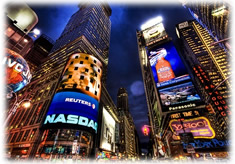 A much-observed marketing trend has been the emergence of "experience retail" which amounts to the merger of shopping and entertainment in an explicit "themed" fashion. Themed retail is a strategy for extending the authority of the brand by taking its meanings into ever more diffuse territories of association, a displacement of object by aura. As a result, Times Square is "Disneyfied" and Fifth Avenue becomes "Las Vegas like" as the aura of exuberant consumption permeatess the frenzy of shoppers and tourists who flock there.
As Times Square becomes ever more Disneyfied, it echoes a growing trend across the ever-increasingly gentrified city streets: a Potemkin Village of identical mainstream content behind a hollowed-out, discarded locality. Even 125th Street has effectively become the urban analogue to a suburban mall. Cleansed of local identity, the street's once singular, if frayed, character is more and more like any other place, anywhere else... a sad side effect of "progress and prosperity."
Lifeless Glitz
Although safer and sounder economically these days, Manhattan begins to look like every other America city (although taller!). Glitzy popular shopping malls and big-box retailers have carved their way into the heart of soul of many neighborhoods, repelling local residents by siphoning customers away from street-level small shops and draining the life out of once vibrant areas.
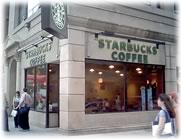 The quaint neighborhood coffee shop has succumbed to a Starbucks around every corner where over-priced coffee choices carry fancy and illogical names for sizes (why isn't a Grande the biggest size? ridiculous B.S!). Getting your caffeine fix at the ubiquitous Starbucks carries with it the aura of "a high class lifestyle" and an invidious push of uniformity in a prepackaged formula of self- authentication.
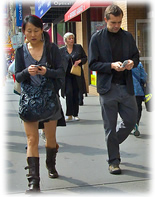 The proliferation of cell phones and tech gadgets have duplicated the disconnected suburban “car” mentality as young professionals move among crowded streets in a self-wrapped bubble, talking on cellphones, listening to iPods and refusing to interact with or take interest in the world around them.
If there is a growing reciprocity between suburban and urban patterns and behaviors, it is clearly mediated by the great equalizers of mass electronic media and the commercial universalism of the all-important Brand. As rampant gentrification and the elevation of shopping and mass entertainment move to the center of our cultural activity and the triumph of branding and multinational economic arrangements became all persuasive; the specific character of the city—with its ability to multiply and magnify differences—risks being reduced to an empty shell, a decorative experience that frames life all too uniform and all too generic.
The Mosaic of Distinctive Neighborhoods
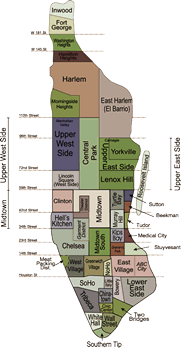
The "magic" of cities lies in its marshaling of a wide diversity of experiences. Every city represents a compendium of places and the pleasure of a city lies in both the special qualities of each neighborhood and in the circulation between their differences.
The mosaic of New York has long been dynamic and varied with a large array of distinctive places—Harlem, Little Italy, Greenwich, Village, The Lower East Side, etc. Its charm and energy is derived from the self-organizing aspects of each of these localities and their unique cultural differences. If suburbanization (or globalization) threatens the city, its danger comes from the devolving uniformity of content—infesting the streetscape with the same commercial retailer's and designer boutiques that can be found anywhere else on the planet ...
What does the future hold for the legendary metropolis, gateway to immigrants and strivers, magnet for builders and dealers, muse for artists and dreamers? Will the current political, economic, and social influences dull its once-famous creative edge and culture of opposition? What will become of the special allure of New York?
Based on the writings of Michael Sorkin
[From the Book --The Suburbanization of New York: Is the World's Greatest City Becoming Just Another Town?
editors: Jerilou Hammett and Kingsley Hammett ] Fair Use Notice